
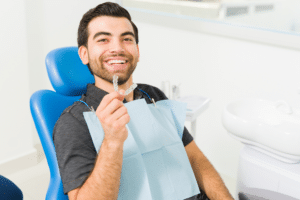
At Brace Connection, Dr. Vahid Babaeian is a board-certified orthodontist and Diamond Invisalign Provider. He checks how the upper and lower teeth meet before recommending care. Patients from Downey, CA and surrounding communities, receive plans based on their bite, tooth position, jaw growth, oral health, and goals.
What Is an Overbite?
An overbite is the vertical overlap of the upper front teeth over the lower front teeth. A small overlap is normal. Treatment may help when the upper teeth cover too much of the lower teeth or place added force on the teeth or gums.
An overbite can be linked to tooth position, jaw growth, crowding, missing teeth, or childhood oral habits. Some people notice only that their upper teeth overlap their lower teeth more than expected. Others may have worn front teeth, sore gums, jaw strain, or trouble biting food.
A bite check can show whether the concern comes from the teeth, the jaws, or both. This matters because clear aligners move teeth, but they cannot fix every jaw growth problem on their own.
How Does Invisalign Correct an Overbite?
Invisalign uses a series of clear, removable trays. Each set moves certain teeth a small amount. The plan may move the front teeth, adjust the back teeth, create space, or guide several teeth at the same time.
Small, tooth-colored attachments may help the trays grip and move certain teeth. Some patients may also need elastics to help the upper and lower teeth fit together.
The American Association of Orthodontists’ clear aligner treatment guidance explains that aligners can treat overbites. It also notes that some cases are easier to treat with braces. Patients must wear their trays for at least 22 hours a day and remove them for meals, brushing, and flossing only.
Since the trays come out, patients can eat their usual foods. They can also brush and floss without brackets or wires in the way.
Which Overbites May Be Treated With Invisalign?
Invisalign may work well for a mild or moderate overbite that can be improved by moving the teeth. Some deep bites may also respond well when the plan includes attachments, elastics, and careful digital scans.
The orthodontist must check more than the front teeth. The exam looks at how much the upper teeth cover the lower teeth, how the back teeth meet, and whether there is crowding or spacing. It also checks whether the lower teeth touch the roof of the mouth or the gums behind the upper teeth.
Age, growth, gum health, bone support, past dental work, and daily aligner wear can also affect the plan. Fixed braces may be easier for patients who may not wear removable trays for the required number of hours.
When Might Braces or Another Treatment Be Better?
Braces may be a better choice for a severe overbite or teeth that need more complex movement. Since brackets and wires stay on the teeth, they provide steady force and do not depend on daily tray wear. Braces can also be used with elastics or other tools to improve the bite.
Some overbites are linked to a large difference in jaw position. Children who are still growing may benefit from early care that guides jaw growth. In severe adult cases, jaw surgery may be part of the treatment plan.
Braces are not better for every deep bite, and Invisalign is not only for simple cases. The right choice is the one that can move the teeth safely and create a stable, comfortable bite.
How Long Does Invisalign Take to Correct an Overbite?
Treatment time depends on the depth of the overbite, the number of teeth that must move, and whether attachments or elastics are needed. Mild cases may take less time. Deep or complex bite problems often need a longer plan.
Daily wear also affects progress. Wearing the trays for fewer hours than directed can slow tooth movement. It may also lead to extra sets of aligners. After the exam and digital scan, the orthodontist can give you a timeline based on your needs.
How Can You Find Out Whether Invisalign Is Right for You?
An orthodontic exam can show what is causing the overbite. Dr. Babaeian can check tooth position, bite function, jaw growth, facial balance, and the amount of movement needed. He can then explain whether Invisalign may work well or whether another option may provide better control.
If you are thinking about Invisalign for an overbite in Downey, CA, contact Brace Connection to schedule a consultation. A personal assessment can help you understand the cause of the bite problem, your treatment choices, and what to expect.